
Giraffe or Wolf Language? How We Help Children Speak From the Heart
We adults tell children constantly to be kind, to share, to say sorry, and then we quietly expect it to take hold. Over my years in the classroom I became more and more convinced that this doesn’t work, at least not on its own. You cannot teach a child to be warm the way you teach them to tie a shoelace. A child who is overwhelmed by anger or hurt cannot simply reach for kind words because we have asked them to.
There is also something we forget too easily. Children speak the way they are spoken to. A child absorbs the tone and rhythm of how people speak to one another long before they grasp the words. So the question that matters to me is not “How do I get children to be nicer?” It is “How do I help children become genuinely aware of what they and others are feeling?” So that warmth comes from the inside, not from a rule on the wall.
This awareness is the foundation everything else at Schola Vera rests on. A child whose heart is in a storm cannot learn, cannot play freely, cannot truly meet another child. Emotional security comes first, and Giraffe and Wolf Language is one of the ways we build it. Let me show you what that looks like with us.
Two animals, one big idea
The approach grows out of Nonviolent Communication, developed by the psychologist Marshall Rosenberg. For adults it can sound rather abstract. Observations, feelings, needs, requests. For children, we make it tangible through two animals.
The giraffe has the largest heart of any land animal, and its long neck lets it see far and wide, taking in the whole situation before reacting. Giraffe language is warm and open. It says what I feel and what I need, and it tells others what is bothering me without wounding them.
The wolf stands for the way all of us sometimes speak when we are frightened or furious. Wolf language snaps, blames and makes the other person small. We are careful to tell the children that real wolves are not bad animals at all, we are only borrowing the picture of snapping and snarling to help them recognise something in themselves.
I want to be clear about one thing, because it shapes how we work: the goal is never to teach children a script of correct sentences. A child can learn all the right words and still use them to get their way. What we are nurturing is not perfect communication, but awareness and empathy. A way of being with others.
Underneath the two animals there is a quiet little movement that giraffe language follows. Instead of “You’re so annoying, mind your own business!”, a child learns to pause and find the pieces hidden inside that outburst. What actually happened, how it made them feel, what they needed, and what they would like instead. “You read out the story I wrote without asking me. I felt embarrassed, because it was private. Next time, could you ask me first?” We don’t drill this as a formula, and we certainly don’t expect children to speak in tidy steps. It is enough that they begin to sense the difference between throwing their feelings at someone and letting that someone understand them.
The words follow the heart, not the other way around.
Part of the fabric of our days
This is where I think we differ from a classroom that runs a one-off “kindness project” and then moves on. For us, this is not a topic to be covered and ticked off. It is woven into the ordinary rhythm of the day, alongside the other practices that make emotional life visible in our community.
It begins long before any conflict, with our weather of feelings, where each child shows whether they feel sunny, cloudy, stormy, rainy inside, and learns, gently and without judgment, that every kind of weather is allowed. Before children can speak the giraffe’s language with others, they need a rich vocabulary for what is happening within themselves. A child who can say “I feel stormy today” is already well on the way to “I felt angry when that happened.” Once a week we gather for our Heart and Storm circle, where children share something they were grateful for and something that troubled them, and then turn that trouble into a wish for the week ahead.
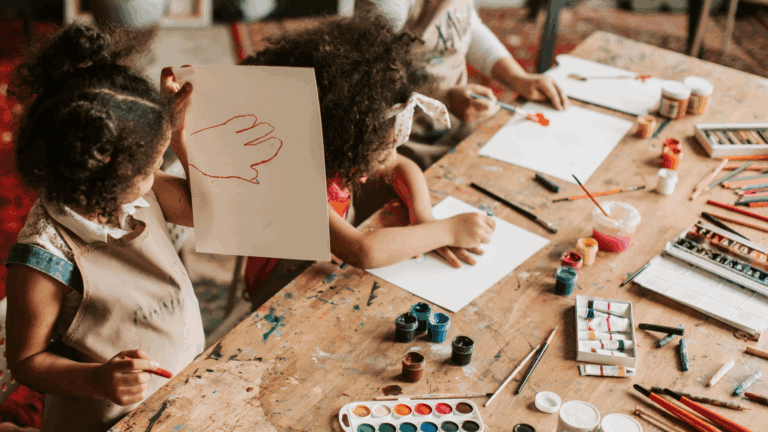
When a conflict does arise, and of course it does, we try not to step in and decide who is right. We see the conflict as something to learn from rather than something to make disappear. We slow down, help the children look at what actually happened without judgment, and then at what each of them was feeling and needing underneath. Often a child simply wants to withdraw for a while first, to a quiet corner, sometimes to write or draw what happened, entirely for themselves and without being interrupted. A surprising amount settles in a child just from putting the whole thing down on paper before anyone else gets involved, and sometimes that quiet pause is all they needed. Our deeper aim is always that the children become able to work things out between themselves, rather than waiting for an adult to decide for them. That is a life skill far more valuable than any solution I could hand them.
What I find most moving is when the children start catching themselves. A child will be halfway into a sharp word, stop, and try again differently, without any reminder from me. The giraffe has moved off the poster and into the room.
A shared language, at school and at home
If your child comes home talking about giraffes and wolves, you are welcome to be curious about it with them. Some parents tell me they find themselves gently asking, “Was that a giraffe thing to say, or a wolf thing?” Not as a correction, but as a small shared language between them and their child. Many say it quietly changes the way they themselves pause before reacting.
We never see this as something parents must do, and certainly not as a way of speaking we would prescribe for your home, because every family has its own warmth and its own rhythm. It is simply that children settle most easily when the grown-ups around them are consistent, and a child who finds the same trust and acceptance at home as they do with us has the firmest ground of all to grow from.
No magic cure
I will end with the thing I most want you to know. Giraffe and Wolf Language is not a magic cure. There will still be the child who melts down again and again, the week where nothing seems to land. When that happens, we try not to ask “How do I make this child stop?” but “What does this child need from me right now?” Behind difficult behaviour there is almost always a need that has not yet been heard, and no clever phrase can stand in for an adult who keeps looking, patiently, for the child underneath.
That patience is really what all of this is about. It rests on a belief that runs through everything we do at Schola Vera: That a child is perfectly good just as they are. We are not teaching children to perform niceness. We are walking alongside them as they learn to understand themselves and reach for one another with open hands. It is slow work, and it is the most worthwhile work I know.
Ready to Give Your Child the Education That Changes Everything?
At Schola Vera, we don’t just talk about natural learning. We live it every day. Our curriculum isn’t a collection of subjects to be mastered or boxes to be ticked. It’s a carefully crafted environment where your child’s innate curiosity, creativity, and joy can flourish without the pressure of grades, tests, or standardised expectations.
When children learn through play, follow their genuine interests, and develop within supportive mixed-age communities, something remarkable happens: they don’t just acquire knowledge. They fall in love with learning itself. They develop the confidence, resilience, and self-direction that will serve them throughout their lives, whatever path they choose.
This is what education can be when we trust children’s natural wisdom and create the conditions for authentic growth. This is what will change everything for your child.