
How Will My Child Cope Without Grades?
On marks, certificates, and the quiet strength we don’t talk about
Someone asked me recently: “How will children without grades ever be prepared for the assessment systems of real life?”
It’s an honest question. And it’s one I hear often, genuinely wanting the best for their child. At a picnic with friends, in conversations at the market, on social media or from other mums at the playground. So I want to take it seriously, and answer it properly. With everything I have learned over a decade in classrooms, everything the research tells us, and everything I believe about what children actually need.
But first, let me answer the question with a different one.
A child who already knows
Imagine a child who really knows that they are good as they are.
A child who doesn’t wait for praise. Who doesn’t hand the question of their own worth over to someone else’s opinion. Who doesn’t lie awake wondering whether the mark they got means they are enough.
How does that child handle being evaluated?
Quite differently from most of us, I suspect. Not because the world stops judging them, the world will always judge, but because their sense of who they are doesn’t live or die by the opinion of others. They can hear feedback, take what’s useful, and walk on. They are, in a quiet and unshowy way, immune. Not immune to the world, but immune to the fear of not being good enough in it.
This is the heart of what I want to explain. The worry behind the original question is real and worth honouring. Parents want their children to be ready. What I’d like to gently turn over is the assumption hiding inside it. The idea that the way to prepare a child for evaluation is to evaluate them constantly.
We prepare children for judgement by judging them
There’s a logic to that idea, and I understand its appeal. It feels like inoculation. A small dose now to build resistance later.
But here’s where I would ask us to pause. We don’t teach children to cope with rejection by rejecting them. We don’t build resilience to cruelty by being cruel. So why do we assume the way to build resilience to evaluation is to subject a six-year-old to it, year after year, until their sense of self has quietly reorganised itself around a number?
This isn’t only my intuition talking. It’s one of the most robustly studied findings in educational psychology and it points in a direction many of us find counterintuitive.
What the research actually says about rewards and marks
The psychologists Edward Deci and Richard Ryan have spent decades studying what motivates human beings, and their work, known as self-determination theory, is among the most empirically validated frameworks in all of psychology. Their conclusion is sobering for anyone who believes grades and gold stars simply add motivation.
In a landmark 1999 meta-analysis pulling together 128 separate experiments, Deci, Koestner and Ryan found that tangible rewards offered for completing or performing a task significantly undermined people’s intrinsic motivation (their genuine, internal desire to do the thing for its own sake). The effect wasn’t marginal. Rewards tied to performance, completion, or simply doing the task all measurably eroded the inner drive that was already there.
The mechanism is what they call the “overjustification effect.” When you reward a child for something they were already enjoying, you quietly shift their understanding of why they’re doing it. Reading stops being something done out of curiosity and becomes something done for the mark. The activity changes, in the child’s own mind, from an end in itself into a means to an external end. And once the reward is removed, the original joy doesn’t reliably come back.
This is the part I find most striking and most relevant to the question I’m asked so often. The theory holds that our motivation is supported by experiences of interest and genuine value, and undermined by the feeling of being externally controlled, whether through rewards or punishments. A grade is both. It rewards and it punishes, every single time.
It would be too easy to stop there, so let me be precise. Deci and Ryan don’t argue that all external feedback is harmful. The research draws a careful line. When feedback serves an informational purpose, helping a learner understand where they are and how to grow, it can actually nourish motivation. It’s when feedback becomes controlling that it does its quiet damage. And a mark out of ten rarely tells a child anything useful about how to grow. It tells them where they sit in a hierarchy.
The neurobiologist’s view: enthusiasm is the fertiliser
The German neurobiologist Gerald Hüther has spent years arguing, to large and sometimes controversial public attention, that much of how we structure schooling works against the brain rather than with it. His central claim is one I find both scientifically grounded and deeply human: the brain consolidates and retains learning not under pressure, but under enthusiasm. Genuine, lasting learning happens, he argues, only when we are emotionally engaged.
Hüther is blunt about what grades actually measure. Good marks, in his view, are largely a measure of how well a child has adapted. How compliant they have learned to be, rather than a measure of intelligence, creativity, or potential. He describes a school system built for the machine age, designed to produce dutiful rule-followers, and warns that what it does to many children is squeeze them through what he memorably calls a sorting machine, where everyone whose gifts don’t fit the narrow analytical-cognitive mould simply falls through.
His prescription is the opposite of pressure and drill: meaning, self-efficacy, and connection. He urges us to step out of what he calls the comparison trap of measuring ourselves endlessly against others and to look on our own mistakes with kindness rather than shame.
Which brings me to mistakes, because I think this is where the whole conversation about grades quietly turns.
On mistakes, and the shame we accidentally teach
A mistake is not a personal failure. It shows us where we can grow. The problem was never the mistake itself. The problem is that we teach children to feel ashamed of them.
The research on this is some of the most hopeful in the whole field. Carol Dweck’s work at Stanford on what she calls the “growth mindset” found that children who understand their abilities can develop through effort and good strategies tend to see mistakes as part of learning. Children with a “fixed mindset,” by contrast, who believe their ability is a static, fixed quantity, experience each mistake as evidence of a permanent deficiency. It demoralises them.
Dweck has found that it isn’t enough for adults to say the right words about growth and effort. What shapes a child’s mindset is how the adults around them actually react to mistakes. When parents, even loving, well-meaning parents who believe in growth, respond to their child’s mistakes as though they are problematic or harmful, the child absorbs the opposite lesson and develops a more fixed view of their own intelligence.
The strength of a community that complements rather than compares
There’s one more piece I want to offer, because it speaks to something we hold dear at Schola Vera and that I rarely see discussed in debates about assessment.
A child who grows up in a community built on complementing one another doesn’t need to compare. They learn, very early and very calmly: I can’t do everything, and I don’t have to. Because beside me are others who can do what I can’t, and I can do what they can’t.
Hüther himself argues that we need a new culture of relationship. That the true treasure of a community is the children growing up within it, each with gifts waiting to be discovered and unfolded. Grades pull in exactly the wrong direction. They rank children against one another along a single line, when what makes a community strong is that its members are different and lean on one another’s differences. Self-determination theory names relatedness, the sense of belonging and being connected, as one of the three fundamental psychological needs that genuine motivation depends on. A league table erodes it. A community nurtures it.
What we do instead
I never want to dodge the practical worry, because it’s the one parents feel in their stomachs at three in the morning: “If there are no grades, how will I know how my child is progressing?”
It’s the right question to ask out loud. I’d just gently suggest that the deeper question underneath it is: “Do I trust my child’s natural capacity to learn and grow?” Because grades, when we are honest, mostly serve to soothe our anxiety as adults. They create the comforting illusion that we can measure and control a child’s development. We reach for them, often, when we lack trust.
At Schola Vera, instead of marks, there is something I believe is far richer:
Individual conversations with the child about their development, interests, and the things lighting them up right now. Treasure books, a kind of living portfolio, that document each child’s real journey rather than reducing it to a number. And reflection practices, where children learn to notice and name their own growth, building the one form of self-assessment that actually serves them for life.
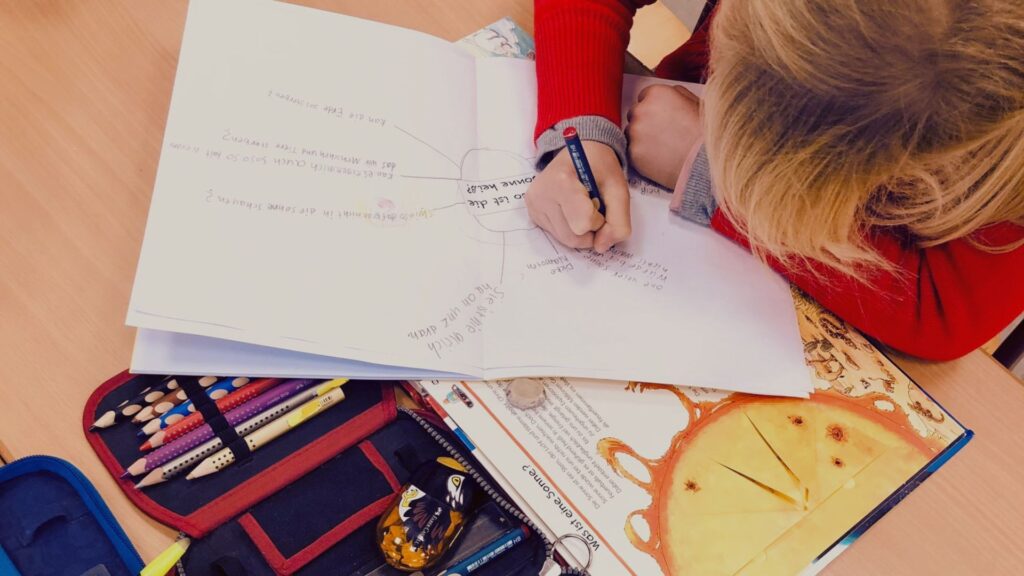
A child who learns to assess their own progress isn’t unprepared for the “real world.” They are more prepared, because they carry the measuring stick inside themselves, where no one can take it away.
What “Real Life” actually asks of us
We talk so much about preparing children for real life. But what do we mean by it?
Do we mean teaching them to adapt? To function? To pin their sense of worth to a figure on a page? Because if that’s the preparation, I’m not sure it’s preparing them for life so much as preparing them to endure it.
There’s a thought I keep returning to, and it overturns the worry I started with. We assume children without grades aren’t ready for the world. But perhaps it’s the other way around. Perhaps it’s the children raised on grades, taught from the age of six that their worth depends on what others decide about them, who arrive less prepared. Not because they lack knowledge, but because somewhere along the way they learned to wait for permission to feel good about themselves.
The goal, as I see it, was never to shield children from the world. It’s to strengthen them so they don’t need to fear it. Not a shield. A foundation.
A child who grows up certain that they are good as they are doesn’t wait for confirmation. Doesn’t wait for praise. Doesn’t wait for a mark. Doesn’t wait for permission.
They simply live.
And honestly? I can’t think of better preparation for real life than that.
Ready to Give Your Child the Education That Changes Everything?
At Schola Vera, we don’t just talk about natural learning. We live it every day. Our curriculum isn’t a collection of subjects to be mastered or boxes to be ticked. It’s a carefully crafted environment where your child’s innate curiosity, creativity, and joy can flourish without the pressure of grades, tests, or standardised expectations.
When children learn through play, follow their genuine interests, and develop within supportive mixed-age communities, something remarkable happens: they don’t just acquire knowledge. They fall in love with learning itself. They develop the confidence, resilience, and self-direction that will serve them throughout their lives, whatever path they choose.
This is what education can be when we trust children’s natural wisdom and create the conditions for authentic growth. This is what will change everything for your child.
Sources
Deci, E. L., Koestner, R., & Ryan, R. M. (1999). A Meta-Analytic Review of Experiments Examining the Effects of Extrinsic Rewards on Intrinsic Motivation. Psychological Bulletin, 125(6), 627–668.
Deci, E. L., Koestner, R., & Ryan, R. M. (2001). Extrinsic Rewards and Intrinsic Motivation in Education: Reconsidered Once Again. Review of Educational Research, 71(1), 1–27.
Ryan, R. M., & Deci, E. L. (2020). Intrinsic and extrinsic motivation from a self-determination theory perspective. Contemporary Educational Psychology, 61.
Hüther, G. (2012). „Jeden Schüler für etwas begeistern” – Interview. taz.
Hüther, G. Jedes Kind ist hoch begabt: Die angeborenen Talente unserer Kinder und was wir aus ihnen machen.
Dweck, C. S. (2006). Mindset: The New Psychology of Success. Ballantine Books.Dweck, C. S. (2015). Carol Dweck Revisits the ‘Growth Mindset’. Education Week.