
Will My Child Find Enough Children Their Own Age?
‘Are there enough children her age?’
It is one of the first things parents want to know about Schola Vera. Sometimes it comes before any question about what children actually do all day. It comes at the market, at a picnic, in a message late in the evening. And I understand it completely. Behind it sits a loving wish: that my child won’t be lonely. That she will find friends. That she will belong.
So I want to take this question seriously and answer it properly. But I also want to turn it over and look at what it rests on. Because I believe it comes from a misunderstanding that almost all of us share, simply because almost all of us went to school.
Most of us spent twelve or thirteen years in a room with people born in the same year as ourselves. From the age of six, our days were organised by birth year. Our friendships, our sports teams, even our birthday parties grew out of that room. So it feels natural. It feels like the way childhood simply is.
Where the question comes from
But it isn’t. Sorting children strictly by age is a surprisingly young idea. For most of human history, children grew up among siblings, cousins and neighbours of every age. Even schools, well into the eighteenth century, usually taught children of very different ages side by side. The graded class came out of Prussia in the nineteenth century and spread from there. The first graded school in the United States, the Quincy Grammar School in Boston, only opened in 1848.
And it wasn’t introduced because anyone had discovered that children learn better or make better friends this way. It was a question of organisation. Reformers such as Horace Mann in the United States hoped graded classes would make schooling more efficient: one teacher, one age group, one programme, everyone moving at the same pace.
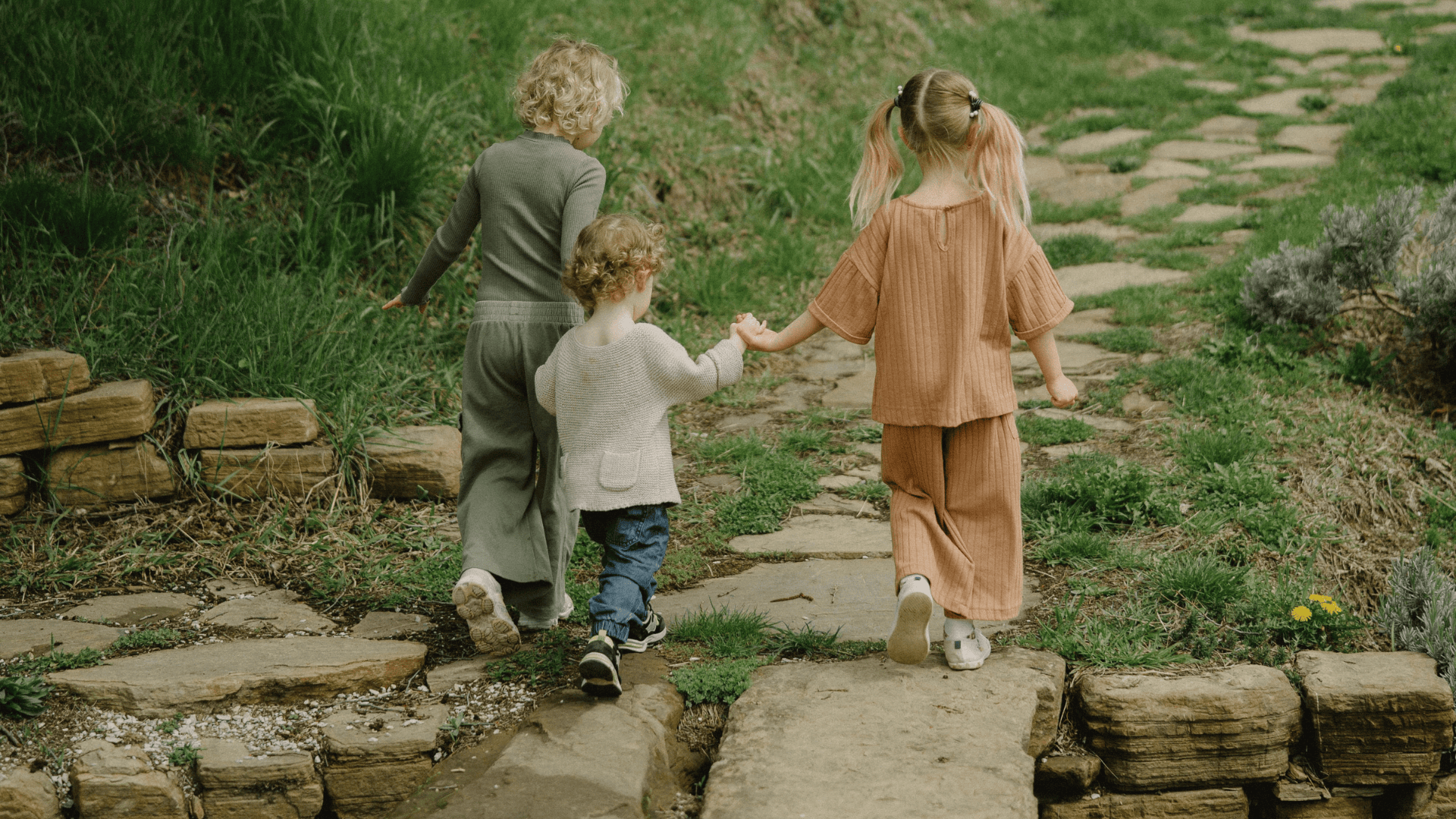
Life itself has never worked like that. Think of the very first community every child belongs to: the family. A baby, an older brother, parents, perhaps grandparents. Nobody is the same age, and nobody would dream of sorting a family by year of birth. That mix is exactly where a child first learns what it means to live with other people.
We have lived with it for so long that we no longer see it. We find it perfectly normal that four-year-olds spend their days with four-year-olds. Yet nobody would put forty-year-olds in a room with only other forty-year-olds and call it a social life. With children, we don’t even think to ask.
Life is not sorted by age
Think about the people who matter most to you. Your partner, your closest friends, the colleague you trust, the neighbour who always has time for a chat, the older woman whose advice you still carry with you. How many of them were born in the same year as you?
As adults, we hardly ever choose people by age. Whether we connect with someone depends on so many other things: a shared sense of humour, a common passion, a similar way of seeing the world, or simply the feeling of being understood. Age rarely makes the list.
And more than that: it is often the people who are most different from us who enrich us the most. Someone who has lived through things we haven’t. Someone who sees the world through a completely different lens. The more different a person is from us, the more there is to discover and to learn. Our lives are made rich by difference, not by similarity.
André Stern, a French author and speaker who never went to school himself and now speaks all over the world about children’s play and enthusiasm, describes how naturally children already live this. For them, age, size and gender simply don’t matter. They meet people as people. It is we adults who hold on to categories that children show us, day after day, they have no need for.
Then there is enthusiasm. The German neurobiologist Gerald Hüther, one of the best-known brain researchers in the German-speaking world, has spent years showing that we learn most deeply when we are enthusiastic. And enthusiasm is rarely sparked by more of the same. It is sparked by the new, by the surprising, by the person who can do something we have never seen before. Hüther puts it simply: whenever something unfamiliar comes into our lives, it is an opportunity. A childhood spent only among equals has fewer of those opportunities.
Not all children like all children
There is a second assumption hidden inside the question: that as soon as enough children of the same age are in one place, play and friendship will simply happen.
Many adults believe this. But think of the last time you stood at a party full of adults, glass in hand, feeling a little lost. Everyone was perfectly pleasant, and still you didn’t really want to talk to anyone. You weren’t being unsociable. You weren’t shy. The right people for you just weren’t there.
Children are equally familiar with this feeling. And in that moment it doesn’t help one bit when an adult says: “Come on, why don’t you go over to Lars? He’s the same age as you!”
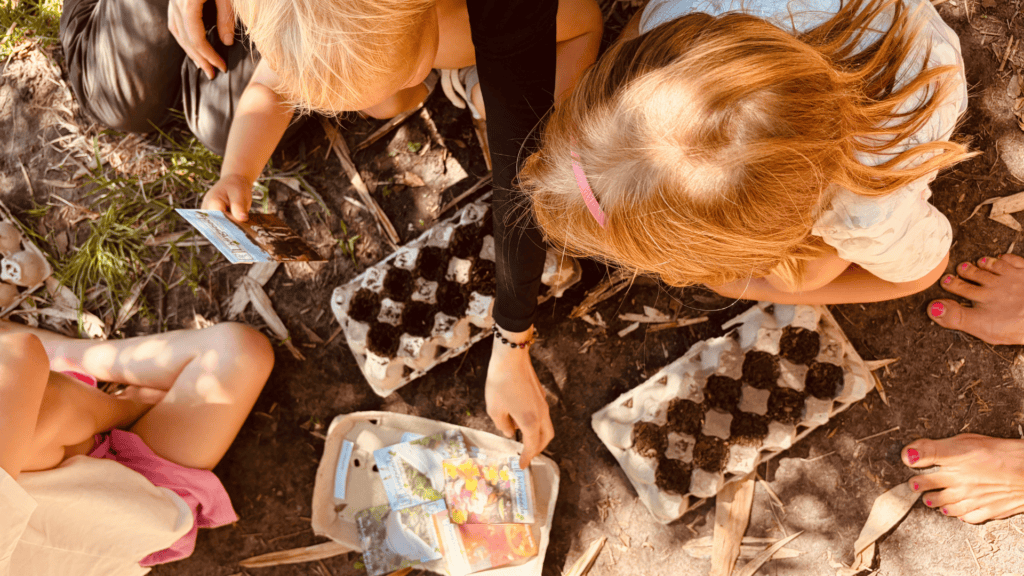
Being the same age has never been a reason for friendship, not for us and not for our children. A child standing at the edge of a group of age-mates is not necessarily struggling socially. Perhaps there is simply no one there who shares her love of beetles, her need for quiet, or her urge to build something enormous. Widen the circle, with younger and older children and adults who are genuinely interested in her, and her chances of finding her people grow enormously.
What happens when everyone is the same age
When children of the same age spend their days together, something predictable happens: they compare. Who can already read? Who runs fastest? Who is the tallest, most clever, most popular?
This is not a flaw in the children. It is how human beings work. In 1954 the American social psychologist Leon Festinger described how we judge our own abilities by comparing ourselves with others, and how we choose people who are similar to us to compare ourselves with. A group in which everyone was born in the same year is the perfect stage for it. When a six-year-old reads more slowly than the eight-year-old beside her, that is simply how things are. When she reads more slowly than every other six-year-old in the room, it becomes a verdict about her.
Festinger also observed that our need for similar others creates pressure towards similarity within a group, and that our urge to be a little better than those we compare ourselves with turns into competition. So same-age groups invite ranking almost by themselves. Grades sharpen this further, as I have written before. But even without a single mark, a room full of same-aged children is a room full of measuring sticks.
In a mixed-age group, this logic quietly falls apart. A twelve-year-old isn’t competing with a seven-year-old. There would be no point. Everyone is obviously at a different point, and that is completely normal. The question stops being “Am I better or worse than the others?” and becomes “Where is my place here, and what do I bring?” Children begin to see themselves as part of a team in which everyone is different and everyone is needed. Not despite the differences, but because of them. Gerald Hüther urges us to step out of what he calls the comparison trap. In a mixed-age community, children never have to walk into it in the first place.
Teenagers: when the peer group becomes the compass
Everything I have described so far grows sharper in adolescence.
Teenagers are living through one of the most turbulent phases of life. Their bodies change, their brains are being rebuilt, and the big questions arrive: Who am I? Where do I belong? What matters? This is the time when young people most need orientation. And it is precisely the time when our system surrounds them, for most of their waking hours, with people who are just as inexperienced, just as unsettled and just as much in search of answers as they are.
The Canadian developmental psychologist Gordon Neufeld and the Hungarian-Canadian physician and bestselling author Gabor Maté describe the result in their book Hold On to Your Kids. They call it peer orientation: young people who take their bearings from one another rather than from the adults in their lives, in questions of what is right, what matters, who they are and how to behave. In the past, they argue, children took their cues from parents, grandparents and teachers. Today many spend their days in large groups of peers with few adults around, and where the bond to adults is weak, children attach to each other instead. Neufeld and Maté connect this with bullying, with a hostile youth culture, and with teenagers who become unreachable for the very people who love them.
Research on the adolescent brain adds a striking detail. In a well-known experiment, the American psychologist Laurence Steinberg, one of the leading researchers on adolescence, and his colleagues at Temple University asked people to play a driving game, either alone or with two peers of the same age in the room. Adults drove the same way in both situations. Young teenagers, around fourteen years old, drove about twice as riskily when their peers were present. Later brain scans showed that simply being observed by peers made the reward centres of the adolescent brain more active. The peer group doesn’t have to say a word. Its presence is enough.
Now picture a fourteen-year-old who spends six or seven hours a day, five days a week, surrounded by other fourteen-year-olds. The audience never leaves.
Gerald Hüther reminds us that children and young people need adults in order to find their way. One of the books he co-wrote carries this in its very title: Kinder suchen Orientierung, children are looking for orientation. The German psychiatrist and psychoanalyst Hans-Joachim Maaz, who for many years ran a psychotherapy clinic in Halle, goes a step further. He argues that what we so readily call “puberty”, with all its conflict, is not an illness but a symptom of disturbed relationships between parents and children. Maaz also describes a society in which fitting in has become more important than being oneself, and he has a name for it: normopathic. Few places push a young person towards the norm as hard as a group of fifteen-year-olds deciding what is cool.
The German philosopher Bertrand Stern, who has spent decades questioning compulsory schooling, looks at the bigger picture. He objects to the idea that children and young people are a different kind of human being: people who are not yet part of life and first have to be prepared for it. School takes them out of the real world and puts them in a kind of practice room. But in life, Stern says, we don’t practise. We live. A fifteen-year-old longs to belong to the real world, to do things that matter, to work alongside adults and to be taken seriously. Instead, we keep young people for years in a waiting room, among themselves, rehearsing for a life that always begins later.
None of this means that friendships between teenagers are a problem. They are precious, and young people need them. The problem is a world in which peers are almost the only people they have.
In a mixed-age community, a teenager’s world looks different. There are younger children who look up to them and whom they can care for. The American psychologist Peter Gray, a research professor at Boston College, and his colleague Jay Feldman observed exactly this at a school where all ages mix freely. Adolescents and young children were drawn to each other by shared interests, by simple liking, and by a mutual wish to care and to be cared for. The little ones, in turn, helped the teenagers become more creative, put into words what they knew, and practise care and leadership. And there are adults who are not there to assess them, but to work alongside them, to listen, and to be someone worth looking up to.
What becomes possible when ages mix
Maria Montessori, the Italian doctor and educator who built her groups across at least three years of age, put it more bluntly than I would dare. Separating people by age, she wrote in The Absorbent Mind, is “one of the cruellest and most inhuman things one can do”, and that applies to children just as much as to adults.
When children are free to choose, they mix. At the Sudbury Valley School in Massachusetts, where pupils between four and eighteen can spend their time with whomever they like, Peter Gray and Jay Feldman found that more than half of all interactions were with someone more than two years older or younger, and a quarter with someone more than four years apart. The school was big enough for everyone to stay with their own age. They simply didn’t.
Gray has a lovely example of why. Two four-year-olds can’t really play catch. Neither throws straight enough for the other to catch, so the game falls apart. A four-year-old and an eight-year-old can. The older child leaps for the wild throws and lobs the ball gently into the little one’s hands, and suddenly both are having fun. The Russian psychologist Lev Vygotsky called this space the zone of proximal development: what a child can already do with someone a little more skilled, but not yet alone. Gray adds something I find beautiful. Older children are often better at this than adults, because they are closer to the younger ones in energy and understanding, and because they don’t feel responsible for anyone’s education, they rarely help more than is wanted. And the older ones enjoy it too. For them it doesn’t feel like a task. It remains play.
Mixed ages also change how we think about learning itself. When I first became a class teacher of a mixed-age group, all the differentiation strategies I had learned simply stopped working: worksheets for different levels, ability groups, tasks in three degrees of difficulty. The span was far too wide. Three levels covered nothing when every child was at a completely different point. So I stopped sorting the children, and found that they didn’t need it. Given the same material, each of them found their own way in. That was the moment I understood that ‘levels’ are something we construct.
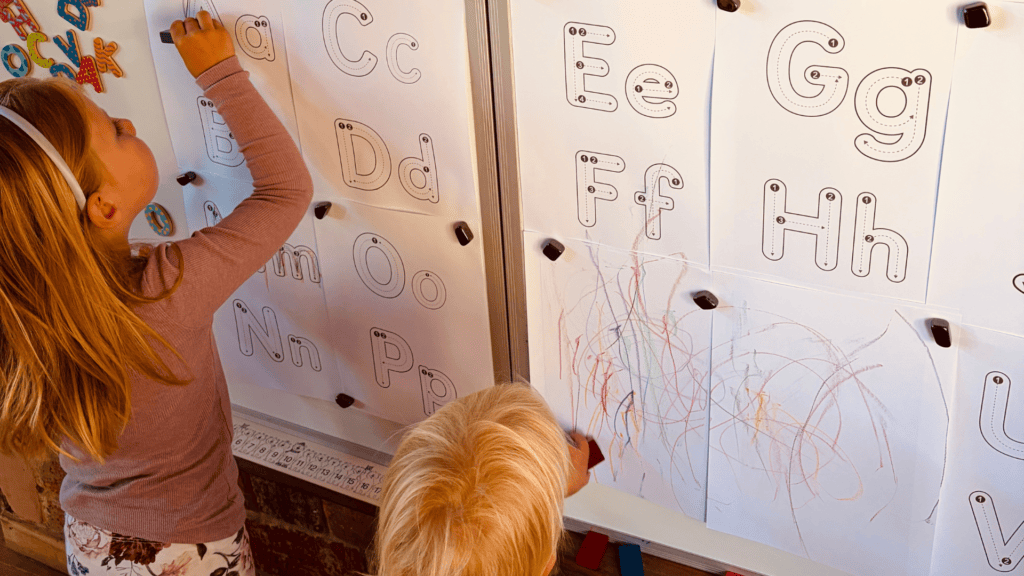
But the deepest gift of mixed ages is not that older children can help younger ones. It is the richness that comes from difference. The little ones bring wonder and an unfiltered curiosity that reminds everyone how astonishing the world is. The older ones bring ideas, skills and plans far bigger than anything a small child could manage alone. The adults bring their experience and their own passions. Everyone gives something, and everyone receives something. At Schola Vera, this is simply everyday life.
Mila, who was never sorted by age
My daughter Mila has never been placed in a same-age group. Nobody ever taught her that her friends ought to be born in the same year as she was. And so she is open to everyone. She doesn’t go looking for children her own age. Quite the opposite: four-year-olds are the ones she finds least interesting of all.
She plays wonderfully, and with striking empathy, with little ones of around two. She dives into imaginary worlds with them, talks with them, and understands what they are trying to tell her. She makes sure they are safe and responds to what they need.
We adults would say: ‘Look how lovingly she looks after the little one.’ but in truth it is her game. It is almost a kind of role play, in which she gets to try out so much. It doesn’t feel like a task to her at all.
Her other friends are between six and ten. With these big children she feels understood. They meet as equals, they build and create together. They rehearse plays and dance performances and design the costumes. They watch birds, build fairy houses, and so much more.
And when you ask Mila who her friends are, she also names adults. People around us who see her and treat her as a person, not as the object “child”. Adults who play, who listen, and who say and do things that inspire her.
Mila is not an exception. She simply shows what children do when nobody tells them where they belong.
Children are looking for people who play
André Stern once said something I keep coming back to. Children, he explained, don’t really go looking for other children. They go looking for the people who play. And since in our society hardly anyone but children still plays, children are all who remain.
He describes what happens when you put an adult who genuinely plays into a room full of children: they rush to that adult. Children want two things at once, Stern says. They want to be like us, and they want to play. As long as we don’t play, they can’t have both.
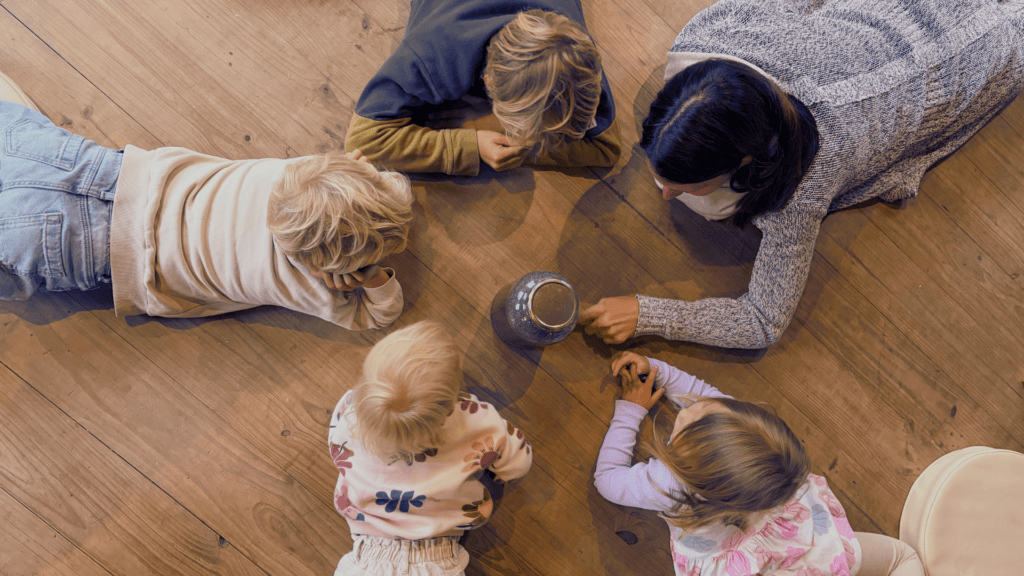
So perhaps ‘Are there enough children her age?’ is not quite the right question. Perhaps the better questions are these. Will my child meet people here who play with her, who take her seriously, who spark her enthusiasm?’ ‘Will there be younger ones she can care for, older ones she can look up to, and adults who see her as a whole person?’
This is why Schola Vera is, quite deliberately, a place where people of different ages come together. Not as a compromise, but because this is what real life looks like, and because we have seen what it does for children.
So when someone asks me whether there will be enough children of her age, I have started answering with a question of my own. Enough for what? Enough to compare herself with? Or enough to find the people who make her eyes light up, whatever their age?
A child who grows up among many ages learns something no same-age class can teach her: that every person, whether younger or older, makes her life richer.
And that she makes theirs richer too.
Ready to Give Your Child the Education That Changes Everything?
At Schola Vera, we don’t just talk about natural learning. We live it every day. Our curriculum isn’t a collection of subjects to be mastered or boxes to be ticked. It’s a carefully crafted environment where your child’s innate curiosity, creativity, and joy can flourish without the pressure of grades, tests, or standardised expectations.
When children learn through play, follow their genuine interests, and develop within supportive mixed-age communities, something remarkable happens: they don’t just acquire knowledge. They fall in love with learning itself. They develop the confidence, resilience, and self-direction that will serve them throughout their lives, whatever path they choose.
This is what education can be when we trust children’s natural wisdom and create the conditions for authentic growth. This is what will change everything for your child.
Sources
- Albert, D., Chein, J., & Steinberg, L. (2013). The teenage brain: Peer influences on adolescent decision making. Current Directions in Psychological Science, 22(2), 114–120.
- Chein, J., Albert, D., O’Brien, L., Uckert, K., & Steinberg, L. (2011). Peers increase adolescent risk taking by enhancing activity in the brain’s reward circuitry. Developmental Science, 14(2).
- Festinger, L. (1954). A theory of social comparison processes. Human Relations, 7(2), 117–140.
- Gardner, M., & Steinberg, L. (2005). Peer influence on risk taking, risk preference, and risky decision making in adolescence and adulthood: An experimental study. Developmental Psychology, 41(4), 625–635.
- Gray, P. (2008). Why we should stop segregating children by age: Part I. Psychology Today.
- Gray, P. (2008). The value of age-mixed play. Education Week.
- Gray, P., & Feldman, J. (1997). Patterns of age mixing and gender mixing among children and adolescents at an ungraded democratic school. Merrill-Palmer Quarterly, 43, 67–86.
- Gray, P., & Feldman, J. (2004). Playing in the zone of proximal development: Qualities of self-directed age mixing between adolescents and young children at a democratic school. American Journal of Education, 110(2), 108–146.
- Gebauer, K., & Hüther, G. (2002). Kinder suchen Orientierung. Walter Verlag.
- Hüther, G. (2015). Viel wichtiger als Wissen ist Erfahrung (interview). Der Standard.
- Hüther, G. Interview on what children need from their fathers. Livenet.
- Maaz, H.-J. (2017). Das falsche Leben: Ursachen und Folgen unserer normopathischen Gesellschaft. C.H. Beck.
- Montessori, M. (1949). The Absorbent Mind.
- National Park Service. Quincy Grammar School.
- Neufeld, G., & Maté, G. (2004). Hold On to Your Kids: Why Parents Need to Matter More Than Peers.
- SAGE. Age grading. Encyclopedia of Educational Reform and Dissent.
- Stern, A. Interview mit André Stern. BabyGuide.
- Stern, A. Interview: Begeisterung, Pubertät, Grenzen und Vertrauen in Kinder. Free Your Family.
- Stern, A. Leben mit Begeisterung: einfach nur Kind sein. Tiroler Tageszeitung.
- Stern, A. (2016). Spielen, um zu fühlen, zu lernen und zu leben. Elisabeth Sandmann Verlag.
- Stern, A. (2019). Begeisterung: Die Energie der Kindheit wiederfinden.
- Stern, B. (2006). Schluss mit Schule! Das Menschenrecht, sich frei zu bilden. tologo verlag.
- Stern, B. (2018). Sternstunde mit Bertrand Stern (interview). Kinderwärts.
- Vygotsky, L. S. (1978). Mind in Society: The Development of Higher Psychological Processes. Harvard University Press.
- Schola Vera. Curriculum, section “Mixed-age learning communities”.